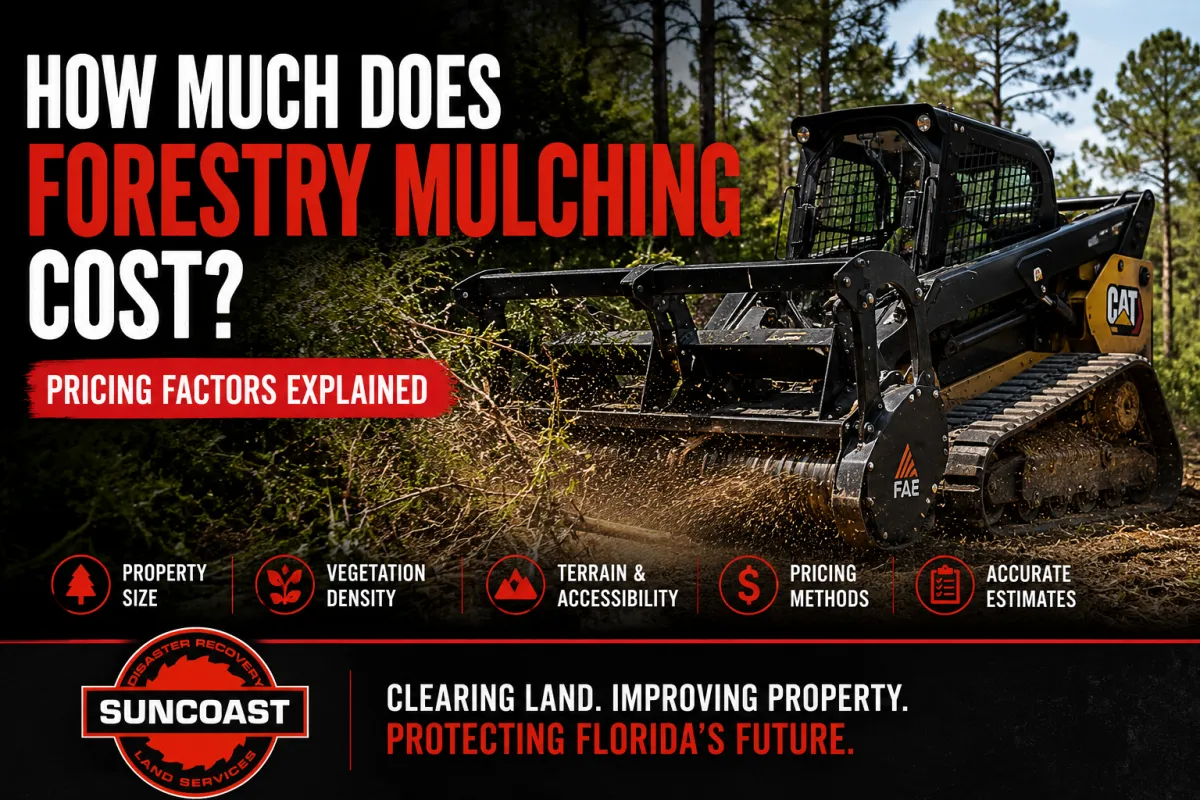
How Much Does Forestry Mulching Cost? Pricing Factors Explained
How Much Does Forestry Mulching Cost?
If you're planning to clear overgrown land, one of the first questions you'll likely ask is:
"How much does forestry mulching cost?"
The answer depends on several factors, including your property's size, vegetation density, terrain, and accessibility. Because every property is different, forestry mulching costs can vary significantly from one project to the next.
In this guide, we'll explain the biggest factors that affect pricing, how contractors typically charge for forestry mulching, and how to get the most accurate estimate for your property.
How Is Forestry Mulching Priced?
Most forestry mulching contractors charge in one of two ways:
By the Acre
Acreage pricing works best when the property has relatively consistent vegetation and terrain, making it easier to estimate the total scope of work. Charging by the acre gives property owners a straightforward estimate for projects such as:
Residential land clearing
Pasture restoration
Hunting property improvements
Agricultural land preparation
By the Hour
Hourly pricing is often the fairest option for projects with unpredictable conditions, such as:
Dense vegetation
Rocky terrain
Steep slopes
Wet areas
Small clearing jobs
Selective clearing around existing structures
Since every property is different, hourly pricing provides flexibility when unexpected conditions are encountered.
What Factors Affect Forestry Mulching Costs?
Several factors influence the total cost of a project.
1. Property Size
Larger properties naturally require more time and equipment to complete. However, larger projects may offer better value per acre than smaller jobs.
2. Vegetation Density
Vegetation density is often the single biggest factor affecting forestry mulching costs. Light brush can often be cleared much faster than dense vegetation containing:
Thick underbrush
Heavy vines
Palmettos
Mature saplings
Dense tree cover
The thicker the vegetation, the longer the project typically takes.
3. Tree Size
Forestry mulching is excellent for clearing:
Brush
Small trees
Saplings
Vines
Shrubs
Larger trees may require separate tree removal before the remaining vegetation can be mulched, which may increase both project time and overall cost.
4. Terrain
Not every property is easy to access.
Project costs may increase when working around:
Hills and slopes
Wet or muddy ground
Rocky areas
Drainage ditches
Uneven terrain
More challenging terrain often requires slower operation and additional care.
5. Accessibility
Equipment must be able to safely reach the work area.
Factors that may affect accessibility include:
Narrow gates
Long driveways
Remote locations
Soft ground
Bridges or culverts
Existing landscaping
Better equipment access often results in a faster, more efficient project, while difficult access may increase labor and equipment time.
6. Desired Finish
Every customer has different goals.
Some property owners simply want thick brush removed, while others want a clean, park-like finish with clearly defined trails and open spaces.
The more refined the finished appearance, the more time may be required to complete the project.
Are There Minimum Charges?
Many contractors have a minimum service charge, especially for smaller projects.
This helps cover transportation, equipment mobilization, fuel, and labor costs—even if the job only takes a few hours.
If you're clearing a small area, ask your contractor whether a minimum project fee applies.
Why Every Property Is Different
No two properties are exactly alike.
Even two one-acre properties located next to each other can require vastly different amounts of work depending on vegetation, tree size, terrain, and accessibility, such as:
One covered in light brush
Another filled with mature trees and dense vegetation
Because of these differences, pricing can vary significantly from one property to another.
How to Get the Most Accurate Estimate
The best way to receive an accurate quote is through an on-site evaluation or by providing clear photos of your property.
A contractor can evaluate:
Property size
Vegetation density
Tree sizes
Terrain
Accessibility
Project goals
This ensures your estimate reflects the actual work required.
Can You Get a Forestry Mulching Estimate Online?
While online pricing calculators can provide a rough idea of potential costs, they cannot accurately account for factors such as vegetation density, terrain, tree size, accessibility, and project goals. For the most reliable estimate, a site visit or a review of detailed property photos is recommended.
Is Forestry Mulching Worth the Cost?
For many property owners, forestry mulching provides excellent long-term value.
It can help:
Increase usable land
Improve property access
Create walking or ATV trails
Restore overgrown pastures
Improve curb appeal
Reduce wildfire fuel
Make future maintenance easier
Instead of simply removing unwanted vegetation, forestry mulching helps transform overgrown property into clean, usable land while minimizing ground disturbance. Whether you're preparing land for construction, restoring pasture, improving access, or enhancing your property's appearance, it can be a cost-effective long-term investment.