Fence Line Clearing in Pasco, Hernando & Citrus County: Why Forestry Mulching Is the Fastest Solution
Fence Line Clearing in Pasco, Hernando & Citrus County: Why Forestry Mulching Is the Fastest Solution
If your fence line is disappearing under thick brush, vines, palmettos, and overgrown vegetation, you are not alone. Property owners throughout Pasco, Hernando, and Citrus County, Florida regularly deal with fast-growing vegetation that can make fence lines difficult to access, maintain, and inspect.
Traditional clearing methods can involve multiple pieces of equipment, hauling away large amounts of debris, and significant labor. Forestry mulching offers a faster and more efficient way to reclaim overgrown fence lines while leaving the property cleaner and easier to maintain.
At Suncoast Forestry Mulching, we help property owners clear unwanted vegetation along fence lines, property boundaries, access areas, and other overgrown sections of land throughout Florida's Nature Coast.
What Is Fence Line Clearing?
Fence line clearing is the process of removing unwanted vegetation and overgrowth along or around a fence.
Over time, fence lines can become covered with:
Palmettos
Brazilian pepper and other invasive vegetation
Thick brush
Vines and weeds
Small trees and saplings
Fallen branches
Dead vegetation
Dense undergrowth
When vegetation grows unchecked, it can hide fence posts, damage fencing, restrict access, and make it difficult to determine exactly where your property boundary begins and ends.
Regular fence line maintenance can help keep these areas accessible, visible, and manageable.
Why Fence Lines Become Overgrown So Quickly in Florida
Florida's warm climate and long growing season create ideal conditions for vegetation growth. In areas throughout Pasco, Hernando, and Citrus County, brush and vegetation can quickly take over neglected fence lines.
Rain, humidity, sunlight, and fertile soil can encourage vegetation to grow rapidly. Vines can climb fencing, brush can spread beneath fence lines, and young trees can eventually become large enough to interfere with the fence itself.
What starts as a small maintenance issue can eventually become a major clearing project.
Why Forestry Mulching Is Ideal for Fence Line Clearing
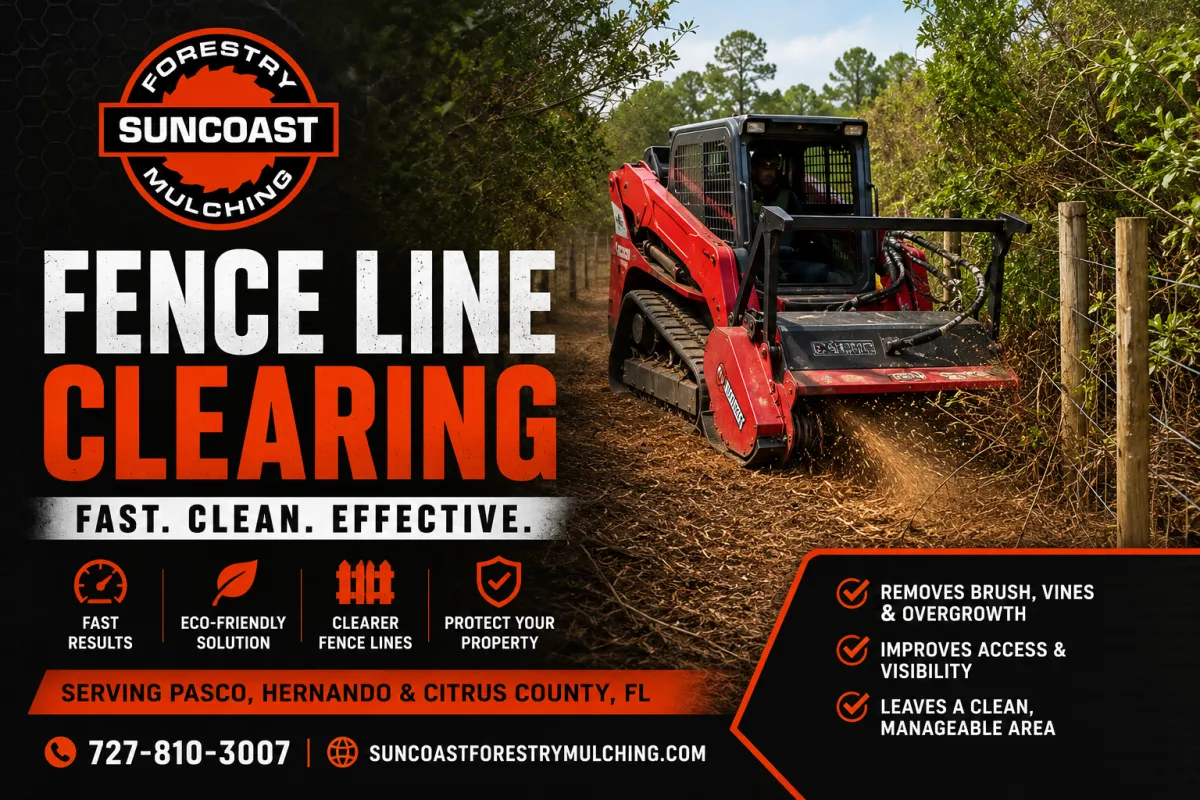
Forestry mulching is one of the most efficient methods for clearing vegetation along fence lines because the machine can cut, grind, and mulch vegetation in a single operation.
Instead of cutting vegetation and then creating piles of debris that need to be removed, a forestry mulcher processes the material and leaves the resulting mulch spread across the ground.
This can significantly reduce the amount of cleanup required after the clearing process.
1. Faster Vegetation Removal
Forestry mulching allows a powerful mulching machine to process brush, vines, and small trees quickly.
Rather than relying on multiple steps such as cutting, piling, loading, hauling, and disposing of vegetation, much of the work can be completed during the mulching operation itself.
That makes forestry mulching an efficient option when you need to reclaim a long or heavily overgrown fence line.
2. Less Debris to Haul Away
Traditional clearing can leave behind large piles of branches, brush, and vegetation.
Those piles have to be moved or hauled away, which adds labor, equipment requirements, and disposal costs.
With forestry mulching, vegetation is processed into small organic mulch that remains on the property.
This can make the entire clearing process cleaner and more efficient.
3. Better Fence Visibility
An overgrown fence line can make it difficult to see fence posts, gates, property boundaries, and areas where the fence may have been damaged.
Clearing the vegetation gives property owners a much clearer view of the fence.
This makes it easier to identify:
Broken fence sections
Damaged posts
Overgrown gates
Fallen trees
Vegetation growing through fencing
Areas requiring repair or replacement
4. Easier Property Maintenance
Once excessive vegetation has been removed, maintaining the fence line becomes much easier.
Instead of allowing dense brush to continue taking over the area, property owners have a cleaner and more accessible space that can be maintained more regularly.
This is especially useful for larger rural properties, ranches, agricultural land, and properties with long fence lines.
5. Helps Reclaim Access
Overgrown fence lines can become difficult or even impossible to walk, inspect, or access with equipment.
Forestry mulching can open up these areas and create a clearer path along the fence.
This can be useful for property inspections, fence repairs, livestock management, land maintenance, and general property access.
Why Fence Lines Become Overgrown So Quickly in Florida
Florida's warm climate and long growing season create ideal conditions for vegetation growth. In areas throughout Pasco, Hernando, and Citrus County, brush and vegetation can quickly take over neglected fence lines.
Rain, humidity, sunlight, and fertile soil can encourage vegetation to grow rapidly. Vines can climb fencing, brush can spread beneath fence lines, and young trees can eventually become large enough to interfere with the fence itself.
What starts as a small maintenance issue can eventually become a major clearing project.
Why Forestry Mulching Is Ideal for Fence Line Clearing
Forestry mulching is one of the most efficient methods for clearing vegetation along fence lines because the machine can cut, grind, and mulch vegetation in a single operation.
Instead of cutting vegetation and then creating piles of debris that need to be removed, a forestry mulcher processes the material and leaves the resulting mulch spread across the ground.
This can significantly reduce the amount of cleanup required after the clearing process.
1. Faster Vegetation Removal
Forestry mulching allows a powerful mulching machine to process brush, vines, and small trees quickly.
Rather than relying on multiple steps such as cutting, piling, loading, hauling, and disposing of vegetation, much of the work can be completed during the mulching operation itself.
That makes forestry mulching an efficient option when you need to reclaim a long or heavily overgrown fence line.
2. Less Debris to Haul Away
Traditional clearing can leave behind large piles of branches, brush, and vegetation.
Those piles have to be moved or hauled away, which adds labor, equipment requirements, and disposal costs.
With forestry mulching, vegetation is processed into small organic mulch that remains on the property.
This can make the entire clearing process cleaner and more efficient.
3. Better Fence Visibility
An overgrown fence line can make it difficult to see fence posts, gates, property boundaries, and areas where the fence may have been damaged.
Clearing the vegetation gives property owners a much clearer view of the fence.
This makes it easier to identify:
Broken fence sections
Damaged posts
Overgrown gates
Fallen trees
Vegetation growing through fencing
Areas requiring repair or replacement
4. Easier Property Maintenance
Once excessive vegetation has been removed, maintaining the fence line becomes much easier.
Instead of allowing dense brush to continue taking over the area, property owners have a cleaner and more accessible space that can be maintained more regularly.
This is especially useful for larger rural properties, ranches, agricultural land, and properties with long fence lines.
5. Helps Reclaim Access
Overgrown fence lines can become difficult or even impossible to walk, inspect, or access with equipment.
Forestry mulching can open up these areas and create a clearer path along the fence.
This can be useful for property inspections, fence repairs, livestock management, land maintenance, and general property access.
Who Can Benefit From Fence Line Clearing?
Fence line clearing is useful for many types of Florida properties.
Residential Properties
Homeowners with large lots may have fence lines that become covered with brush, vines, and unwanted vegetation.
Clearing these areas can improve visibility, accessibility, and overall property appearance.
Ranches and Agricultural Properties
Ranches and agricultural properties often have long fence lines that can be difficult to maintain manually.
Keeping these areas clear can make it easier to inspect fencing, manage property boundaries, and maintain access around the property.
Vacant Land
If you own undeveloped or vacant land, vegetation can quickly grow around existing fences and property boundaries.
Forestry mulching can help reclaim these areas before the vegetation becomes even more difficult to manage.
Commercial Properties
Commercial landowners and developers may need fence lines cleared before construction, property improvements, or other site work begins.
Clearing vegetation can provide better access and visibility around the property.
Fence Line Clearing in Pasco County
Pasco County has a mixture of residential properties, rural acreage, agricultural land, and undeveloped parcels. Many properties experience significant vegetation growth, particularly in areas that have not been regularly maintained.
Forestry mulching can help Pasco County property owners reclaim overgrown fence lines without creating massive piles of brush that need to be hauled away.
Whether you need a short residential fence line cleared or several thousand feet of vegetation removed from a larger property, the right equipment and clearing approach can make a major difference.
Fence Line Clearing in Hernando County
Hernando County is known for its rural properties, wooded acreage, farms, and large residential lots.
These properties can develop dense vegetation along fences and property boundaries.
Forestry mulching provides an efficient way to reduce heavy brush, vines, small trees, and other unwanted vegetation while improving access along the fence line.
Fence Line Clearing in Citrus County
Citrus County properties can also experience thick vegetation and rapid regrowth.
For landowners dealing with neglected fence lines, forestry mulching can provide a practical way to reclaim the area and make future maintenance easier.
It can be particularly useful for rural acreage, vacant land, agricultural properties, and larger residential lots.
What Happens During a Fence Line Clearing Project?
Every property is different, but a typical forestry mulching project may include the following steps:
1. Property Assessment
The first step is evaluating the fence line and determining the type and density of vegetation.
We look at factors such as:
Fence condition
Vegetation density
Tree and brush size
Terrain
Access for equipment
Length of the fence line
Desired clearing width
2. Clearing and Mulching
Once the project is planned, the forestry mulching equipment works along the designated fence line.
Brush, vines, and suitable trees are cut and processed into mulch.
3. Ground-Level Cleanup
The goal is to leave the cleared area more accessible and manageable, with the processed vegetation distributed across the ground.
4. Final Inspection
After clearing, the fence line can be inspected to identify any remaining vegetation, damaged fence sections, gates, or areas requiring additional work.
How Much Does Fence Line Clearing Cost?
The cost of fence line clearing depends on several factors, so there is no single price that applies to every property.
Important factors include:
Total fence line length
Vegetation density
Size of trees and brush
Terrain and ground conditions
Equipment access
Desired clearing width
Amount of additional cleanup required
At Suncoast Forestry Mulching, we evaluate the property and project requirements before providing an estimate.
Don't Wait Until Your Fence Is Completely Overgrown
Fence line maintenance is much easier when vegetation is addressed before it becomes a major problem.
If vines are already covering the fence, brush is hiding the posts, and trees are growing into the fencing, waiting can make the project more difficult.
Regular clearing can help keep fence lines accessible and prevent vegetation from becoming an even bigger maintenance issue.
Fence line clearing is useful for many types of Florida properties.
Fence Line Clearing in Pasco County
Pasco County has a mixture of residential properties, rural acreage, agricultural land, and undeveloped parcels. Many properties experience significant vegetation growth, particularly in areas that have not been regularly maintained.
Forestry mulching can help Pasco County property owners reclaim overgrown fence lines without creating massive piles of brush that need to be hauled away.
Whether you need a short residential fence line cleared or several thousand feet of vegetation removed from a larger property, the right equipment and clearing approach can make a major difference.
Fence Line Clearing in Hernando County
Hernando County is known for its rural properties, wooded acreage, farms, and large residential lots.
These properties can develop dense vegetation along fences and property boundaries.
Forestry mulching provides an efficient way to reduce heavy brush, vines, small trees, and other unwanted vegetation while improving access along the fence line.
Fence Line Clearing in Citrus County
Citrus County properties can also experience thick vegetation and rapid regrowth.
For landowners dealing with neglected fence lines, forestry mulching can provide a practical way to reclaim the area and make future maintenance easier.
It can be particularly useful for rural acreage, vacant land, agricultural properties, and larger residential lots.
What Happens During a Fence Line Clearing Project?
Every property is different, but a typical forestry mulching project may include the following steps:
1. Property Assessment
The first step is evaluating the fence line and determining the type and density of vegetation.
We look at factors such as:
Fence condition
Vegetation density
Tree and brush size
Terrain
Access for equipment
Length of the fence line
Desired clearing width
2. Clearing and Mulching
Once the project is planned, the forestry mulching equipment works along the designated fence line.
Brush, vines, and suitable trees are cut and processed into mulch.
3. Ground-Level Cleanup
The goal is to leave the cleared area more accessible and manageable, with the processed vegetation distributed across the ground.
4. Final Inspection
After clearing, the fence line can be inspected to identify any remaining vegetation, damaged fence sections, gates, or areas requiring additional work.
How Much Does Fence Line Clearing Cost?
The cost of fence line clearing depends on several factors, so there is no single price that applies to every property.
Important factors include:
Total fence line length
Vegetation density
Size of trees and brush
Terrain and ground conditions
Equipment access
Desired clearing width
Amount of additional cleanup required
At Suncoast Forestry Mulching, we evaluate the property and project requirements before providing an estimate.
Don't Wait Until Your Fence Is Completely Overgrown
Fence line maintenance is much easier when vegetation is addressed before it becomes a major problem.
If vines are already covering the fence, brush is hiding the posts, and trees are growing into the fencing, waiting can make the project more difficult.
Regular clearing can help keep fence lines accessible and prevent vegetation from becoming an even bigger maintenance issue.