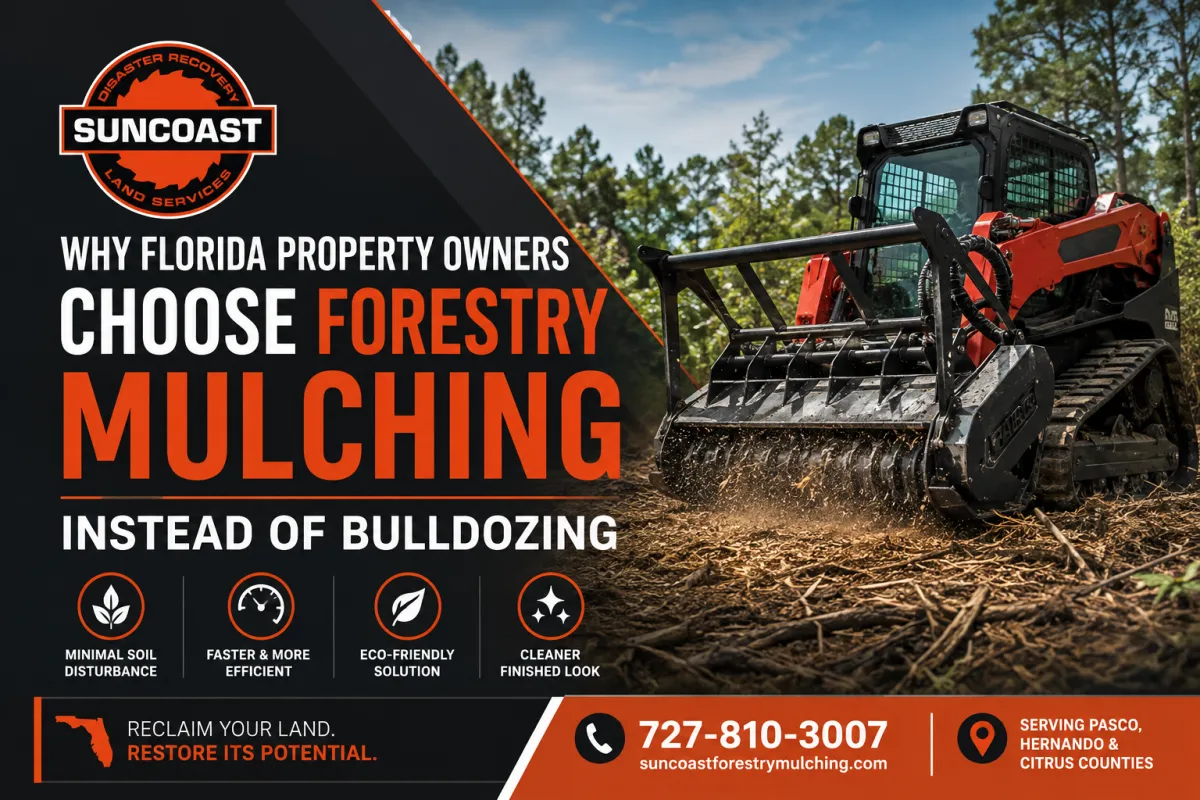
Why Florida Property Owners Choose Forestry Mulching Instead of Bulldozing
Why Florida Property Owners Choose Forestry Mulching Instead of Bulldozing
Clearing overgrown land in Florida can be a major project. Whether you are preparing a property for construction, reclaiming an overgrown pasture, improving access roads, or simply taking back control of your land, choosing the right land-clearing method can make a significant difference.
For many Florida property owners, forestry mulching is a better alternative to traditional bulldozing.
Instead of pushing vegetation into piles and leaving behind large amounts of debris, forestry mulching uses specialized equipment to cut, grind, and mulch trees, brush, vines, and overgrowth directly back into the soil.
For properties throughout Pasco County, Hernando County, Citrus County, and Florida's Nature Coast, forestry mulching can provide an efficient way to reclaim land while minimizing unnecessary disturbance.
What Is Forestry Mulching?
Forestry mulching is a land-clearing process that uses a specialized mulching machine to cut and grind vegetation into small organic material.
A forestry mulcher can typically handle:
Small to medium-sized trees
Palmetto and saw palmetto
Dense brush
Overgrown vegetation
Vines and invasive growth
Small trees and saplings
Fallen branches and woody debris
Thick underbrush
Property-line overgrowth
Rather than removing every piece of vegetation from the property, the machine processes much of the material where it stands.
The result is a layer of organic mulch that remains on the ground and can gradually break down naturally.
This is one of the biggest differences between forestry mulching and bulldozing.
Forestry Mulching vs. Bulldozing
Traditional bulldozing is often used for large-scale land clearing. A bulldozer can push over trees, remove vegetation, scrape soil, and create large piles of debris.
While bulldozing can be appropriate for certain projects, it may be more aggressive than necessary for properties where the primary goal is to remove vegetation and reclaim usable space.
Forestry mulching takes a different approach.
Bulldozing
Bulldozing typically involves:
Pushing trees and vegetation over
Moving large amounts of soil
Creating debris piles
Potentially disturbing the existing grade
Requiring additional cleanup or hauling
Leaving the property needing further preparation
Forestry Mulching
Forestry mulching typically involves:
Cutting vegetation at the ground level
Grinding vegetation into mulch
Leaving organic material on the property
Minimizing unnecessary soil disturbance
Reducing debris piles
Creating a cleaner finished appearance
The best method depends on the property and the project's goals, but for many landowners, forestry mulching provides a more efficient way to deal with unwanted vegetation.
1. Forestry Mulching Can Minimize Soil Disturbance
Florida properties can have sandy soils, drainage considerations, established vegetation, and uneven terrain.
Heavy land-clearing equipment can disturb the ground when vegetation is pushed, uprooted, or excavated.
Forestry mulching focuses primarily on processing vegetation rather than completely stripping the property.
Because the process can leave much of the existing soil and root structure undisturbed, it can be a practical choice when the goal is vegetation management rather than complete excavation.
This can be particularly useful for properties where maintaining the existing terrain is important.
2. There Is Less Debris to Haul Away
One of the biggest advantages of forestry mulching is what happens to the vegetation after it is cut.
With traditional clearing, trees and brush may be pushed into large piles that eventually need to be burned, hauled away, or processed separately.
Forestry mulching handles much of that material during the clearing process.
The vegetation is shredded into mulch and distributed across the cleared area.
That means property owners may not have to deal with the same volume of brush piles and loose debris left behind by conventional clearing methods.
For many projects, this can simplify the cleanup process and reduce the number of steps required to get the property ready for its next use.
3. Forestry Mulching Can Be Faster for Certain Properties
Land clearing time depends on vegetation density, property size, terrain, access, and the type of clearing required.
However, forestry mulching can be highly efficient because the machine can cut and process vegetation in a single operation.
Instead of:
Cut → Push → Pile → Load → Haul → Clean Up
the process can often be closer to:
Cut → Mulch → Spread
That streamlined process is one reason many property owners consider forestry mulching when dealing with overgrown land.
4. It Can Leave the Property Looking Cleaner
A property covered in dense brush, vines, and unwanted vegetation can be difficult to use.
After forestry mulching, the land can have a much more open and manageable appearance.
Clearing can reveal:
Property boundaries
Existing trees
Access roads
Trails
Fence lines
Building sites
Pastures
Drainage areas
Previously unusable sections of the property
The result is not simply a cleared property—it can be a property that is easier to see, access, maintain, and plan for.
5. Mulch Can Stay on the Ground
Unlike traditional clearing methods that may require vegetation to be removed from the property, forestry mulching processes the vegetation into organic mulch.
That material can remain on the ground as a protective layer.
Over time, organic material can break down and return nutrients to the soil.
Mulch can also help reduce exposed bare soil and can provide a more natural-looking finish compared with a property covered in piles of uprooted vegetation.
The exact result depends on the vegetation, soil conditions, weather, and the specific project.
6. Forestry Mulching Is Ideal for Overgrown Florida Properties
Florida's warm climate allows vegetation to grow quickly.
Palmettos, vines, brush, weeds, and fast-growing trees can quickly take over unused portions of a property.
A property that was manageable a few years ago can become heavily overgrown if it is not maintained.
Forestry mulching can be particularly useful for:
Residential Properties
Homeowners may use forestry mulching to reclaim portions of their property that have become overgrown.
Common projects include:
Backyard clearing
Lot clearing
Driveway access
Fence-line clearing
Property-line maintenance
Removing dense brush
Preparing areas for landscaping
Agricultural and Pasture Properties
Farm and ranch properties may require vegetation management to reclaim overgrown pasture, improve access, or maintain property boundaries.
Forestry mulching can help clear unwanted brush and vegetation without requiring every piece of material to be removed from the property.
Commercial Properties
Developers and commercial property owners may need to clear vegetation before construction, expansion, access improvements, or site preparation.
Forestry mulching can be considered as an initial vegetation-clearing step before additional site work.
Trails and Access Roads
Dense vegetation can make portions of a property difficult or impossible to access.
Forestry mulching can help establish or reopen:
Trails
Access paths
Fire lanes
Equipment routes
Property entrances
Utility access areas
7. It Can Be Better Suited for Uneven or Difficult Terrain
Not every property is a flat, open field.
Florida land can include wooded areas, uneven terrain, dense vegetation, narrow access points, and areas where maneuverability matters.
Forestry mulching equipment can be useful in situations where traditional clearing equipment may not be the most practical choice.
A professional site assessment can determine whether forestry mulching is appropriate for the terrain, vegetation, and accessibility of a specific property.
8. It Can Reduce the Need for Multiple Clearing Steps
Traditional land clearing may involve several pieces of equipment and separate stages.
For example:
Trees are cut.
Vegetation is pushed into piles.
Debris is loaded.
Material is hauled away.
The site is cleaned.
Additional grading may be required.
Forestry mulching can combine much of the vegetation-clearing process into one operation.
That does not mean every property can be completely prepared with forestry mulching alone. Construction sites, driveways, building pads, drainage projects, and other developments may still require excavation, grading, hauling, stump removal, or additional site preparation.
But when the primary problem is overgrown vegetation, forestry mulching can be a highly efficient solution.
9. It Can Help Reclaim Unusable Land
One of the biggest benefits of forestry mulching is the ability to turn neglected areas into usable space.
An overgrown property may contain acres of land that are technically owned but practically unusable because of thick vegetation.
After clearing, that same space may be suitable for:
Trails
Pasture
Recreational areas
Equipment access
Hunting access
Fencing
Future construction
Landscaping
Property maintenance
Instead of allowing vegetation to continue taking over the property, landowners can reclaim the space and make better use of their acreage.
10. Forestry Mulching Can Be a More Targeted Approach
Bulldozing is generally designed to move material.
Forestry mulching is designed to process vegetation.
That distinction matters.
If you want to completely reshape the land, remove soil, excavate a building pad, or perform major grading, a bulldozer or other heavy equipment may be necessary.
But if your primary goal is to remove thick vegetation while keeping the existing landscape relatively intact, forestry mulching may be the better fit.
When Should You Choose Bulldozing Instead?
Forestry mulching is not the right solution for every property.
Bulldozing, excavation, or other heavy equipment may be more appropriate when a project requires:
Major grading
Extensive excavation
Building pad preparation
Large-scale soil removal
Complete root removal
Large stump removal
Road construction
Pond excavation
Significant terrain changes
The right clearing method depends on what you ultimately want to do with the property.
A professional land-clearing contractor can evaluate the property and recommend the appropriate approach.
What Does Forestry Mulching Cost in Florida?
Forestry mulching costs vary from property to property.
Some of the factors that can affect the price include:
Property size
Vegetation density
Tree size
Terrain
Accessibility
Amount of underbrush
Distance from the work area
Additional services required
Stump or root removal
Debris hauling
Grading requirements
A lightly overgrown property will generally require less work than land covered with extremely dense vegetation and larger trees.
That is why an accurate estimate should be based on the actual conditions of the property rather than acreage alone.
Is Forestry Mulching Environmentally Friendly?
Forestry mulching can be a more targeted land-clearing method because it processes vegetation on-site and can reduce the need to haul large volumes of organic debris away.
It also avoids the need to create large debris piles for many types of clearing projects.
However, "environmentally friendly" does not mean every forestry mulching project has zero environmental impact.
Responsible land clearing still requires consideration of:
Protected trees
Wetlands
Drainage
Wildlife
Erosion
Property boundaries
Local regulations
Required permits
Before clearing land, property owners should make sure their project complies with applicable local, county, state, and environmental requirements.