Forestry Mulching vs Excavation: Which Is Right for Your Property?
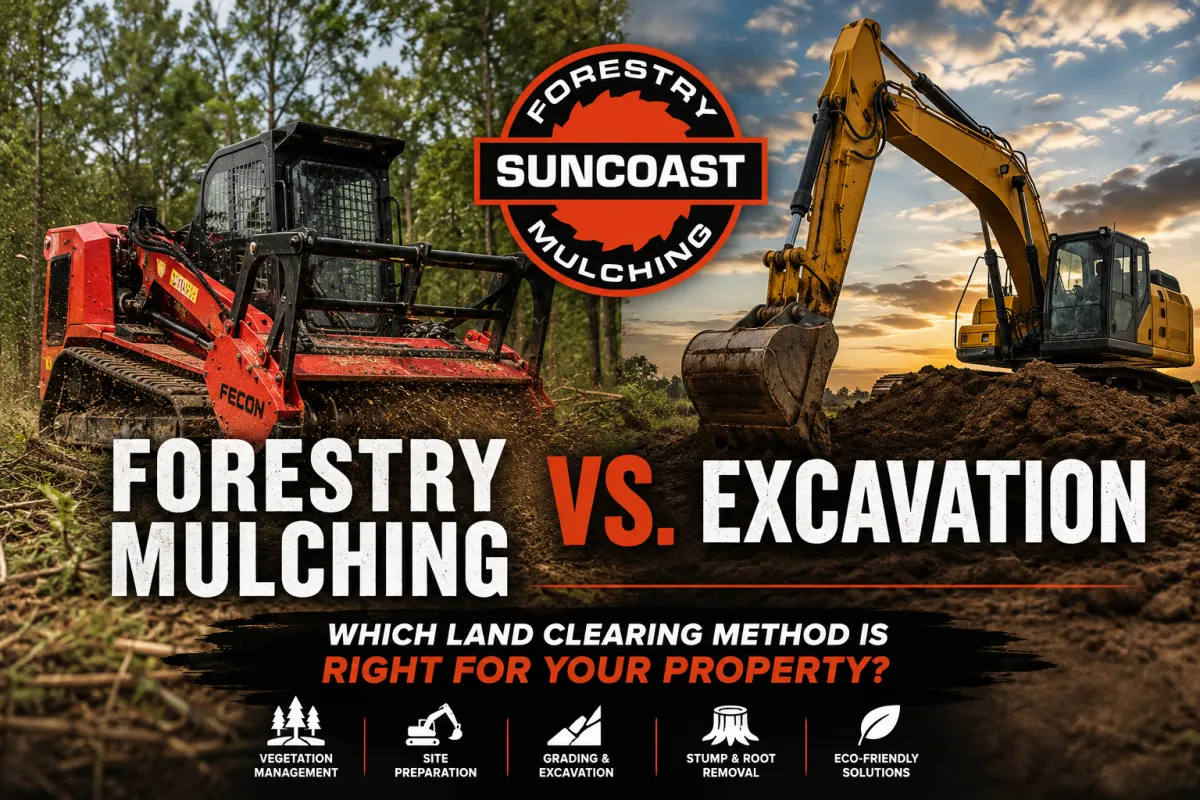
Forestry Mulching vs. Excavation: Which Land Clearing Method Is Right for Your Property?
Clearing overgrown land is an important first step for many property improvement and development projects. Whether you're preparing land for a new home, creating access roads, reclaiming an overgrown lot, improving a hunting property, or managing unwanted vegetation, choosing the right clearing method can make a major difference.
Two common approaches are forestry mulching and excavation.
While both can be effective, they serve different purposes. Forestry mulching is primarily designed to remove and process unwanted vegetation, while excavation focuses more on moving soil, removing stumps and roots, grading land, and changing the property's terrain.
Understanding the difference between forestry mulching vs. excavation can help you choose the right solution for your property and avoid paying for more work than your project actually requires.
What Is Forestry Mulching?
Forestry mulching is a land-clearing method that uses specialized equipment to cut, grind, and mulch trees, brush, vines, and other unwanted vegetation directly on the property.
Instead of cutting vegetation and hauling it away, a forestry mulcher processes the material into a layer of organic mulch that remains on the ground.
This makes forestry mulching an efficient option for properties with:
Overgrown brush
Small to medium-sized trees
Thick vegetation
Vines and invasive growth
Unused areas that need to be reclaimed
Overgrown fence lines
Hunting trails and access paths
Pasture edges
Residential lots with unwanted vegetation
One of the biggest advantages of forestry mulching is that it can significantly reduce the amount of debris that needs to be removed from the property.
What Is Excavation?
Excavation involves digging, removing, moving, or reshaping soil and other materials on a property.
Excavation equipment such as excavators, skid steers, and other heavy machinery can be used to:
Remove stumps
Dig foundations
Move soil
Grade land
Create drainage areas
Prepare building pads
Dig trenches
Remove large roots
Reshape terrain
Prepare sites for construction
Excavation is especially important when a project requires changes to the property's elevation, soil structure, drainage, or grade.
For example, if you're preparing a property for a new home, excavation may be necessary after vegetation has been cleared to prepare the site for the foundation.
Forestry Mulching vs. Excavation: What's the Difference?
The biggest difference is what each method is designed to accomplish.
Forestry mulching is primarily a vegetation management and land-clearing solution.
Excavation is primarily a soil-moving and terrain-preparation solution.
A forestry mulcher can process trees, brush, and vegetation without requiring every piece of material to be removed from the property. Excavation equipment, on the other hand, is designed to dig into the ground, remove material, and move soil.
In many cases, these services are not competing solutions. They can actually be used together as part of a larger land development project.
When Forestry Mulching Is the Better Choice
Forestry mulching may be the better option when your primary problem is overgrown vegetation.
For example, you may benefit from forestry mulching if you have a property that has been neglected and is now covered in thick brush, small trees, vines, and unwanted growth.
1. Clearing Overgrown Lots
An overgrown lot can become difficult to access and maintain.
Forestry mulching can help reclaim areas that have become covered with unwanted vegetation, making the property easier to access and manage.
2. Creating Trails and Access Roads
Forestry mulching can be an efficient way to establish paths through wooded or overgrown areas.
This can be useful for:
Hunting properties
Rural properties
Agricultural land
Recreational land
Utility access
Maintenance roads
3. Maintaining Fence Lines
Vegetation can quickly grow along fences and make maintenance difficult.
Forestry mulching can help clear unwanted brush and vegetation along fence lines while minimizing the need to haul large amounts of debris away.
4. Reclaiming Unused Land
If part of your property has become unusable because of thick vegetation, forestry mulching can help open the area back up.
Once vegetation is cleared, the property can be easier to inspect, maintain, and use.
5. Preparing Land for Future Development
Forestry mulching can also be useful as an initial clearing step before construction or other site work.
However, additional services such as excavation, grading, stump removal, or site preparation may still be necessary depending on the project.
When Excavation Is the Better Choice
Excavation is generally more appropriate when your project involves soil removal, grading, digging, or significant changes to the terrain.
Examples include:
Foundation Preparation
Building a home or structure often requires excavation to prepare the area for a foundation.
Drainage Work
If your property has drainage problems, excavation may be needed to create or modify drainage channels, swales, or other site features.
Grading
Grading changes the slope or elevation of the land to create a more suitable surface for construction, driveways, drainage, or other improvements.
Stump and Root Removal
Large stumps and extensive root systems may require excavation equipment to completely remove them from the ground.
Soil Removal and Relocation
If soil needs to be removed, transported, or redistributed around the property, excavation equipment is typically more appropriate than a forestry mulcher.
Forestry Mulching Can Be More Efficient for Vegetation
One major reason property owners choose forestry mulching is efficiency.
Traditional clearing can involve multiple steps:
Cut trees and brush.
Stack or pile debris.
Load debris.
Haul debris away.
Clean up the site.
Forestry mulching can simplify much of this process by cutting and processing vegetation on-site.
The vegetation is turned into mulch and distributed across the cleared area, reducing the amount of material that needs to be piled and hauled away.
This can make forestry mulching particularly attractive for properties where the primary goal is vegetation removal rather than soil excavation.
Does Forestry Mulching Remove Stumps?
This is an important distinction when comparing forestry mulching vs. excavation.
Forestry mulching generally processes vegetation at or near ground level, but it does not necessarily provide the same type of deep stump and root removal that excavation can provide.
If your project requires complete stump removal because you need to build a foundation, install certain utilities, or significantly regrade the property, excavation or specialized stump-removal work may be necessary.
The right approach depends on what you plan to do with the land after clearing.
Can Forestry Mulching and Excavation Be Used Together?
Yes.
In fact, many land-clearing and construction projects may benefit from using both methods.
For example, imagine you're preparing a heavily overgrown property for a new home.
A project may involve:
Step 1: Forestry Mulching
Unwanted trees, brush, vines, and vegetation are cleared and mulched.
Step 2: Stump or Root Removal
Specific stumps or root systems that interfere with construction can be removed.
Step 3: Excavation
The construction area can then be excavated as needed for the foundation or other site requirements.
Step 4: Grading
The site can be shaped and leveled according to the project's requirements.
Using the right equipment for each stage can make the overall project more efficient and help prevent unnecessary work.
Which Is More Environmentally Friendly?
Forestry mulching can be a lower-impact clearing option for many vegetation-management projects because the vegetation is processed on-site rather than being cut, piled, loaded, and transported away.
The resulting mulch can help return organic material to the soil and reduce the need for hauling large volumes of vegetation.
However, every property is different. Terrain, vegetation type, soil conditions, drainage, protected areas, and the intended use of the land should all be considered before choosing a clearing method.
Forestry Mulching vs. Excavation: Which One Do You Need?
The answer depends on your project's goal.
Choose forestry mulching when your primary objective is to:
Remove overgrown vegetation
Clear brush
Manage small to medium-sized trees
Reclaim neglected land
Create trails
Open access areas
Maintain fence lines
Improve property visibility
Prepare an area for future work
Choose excavation when your project requires you to:
Move soil
Dig foundations
Remove large stumps or roots
Change elevations
Grade the property
Improve drainage
Dig trenches
Prepare building pads
Reshape terrain
And for many construction projects, you may need both.
What About Cost?
The cost of land clearing and excavation varies significantly depending on the property and scope of work.
Factors that can affect the price include:
Property size
Vegetation density
Tree size
Terrain
Accessibility
Soil conditions
Amount of material to be removed
Stump and root requirements
Grading requirements
Project location
Final intended use of the property
Because every property is different, an on-site assessment is often the best way to determine which method is appropriate and what the project may require.
The cheapest method is not always the best method. Choosing equipment based on the actual scope of work can help avoid unnecessary labor, hauling, and additional site preparation.
Why Choose Professional Forestry Mulching?
Professional forestry mulching can provide an efficient way to reclaim and manage overgrown property without relying on traditional cut-and-haul clearing for every project.
At Suncoast Forestry Mulching, we help property owners tackle unwanted vegetation and reclaim usable space throughout Pasco County and surrounding areas.
Whether you're dealing with an overgrown residential lot, wooded property, hunting land, agricultural acreage, or land being prepared for future development, the right clearing strategy can make a significant difference.
Our goal is to help you understand what your property needs before unnecessary work begins.
Final Thoughts: Forestry Mulching vs. Excavation
When comparing forestry mulching vs. excavation, the most important question is not which method is universally better.
It's what does your property actually need?
If your main problem is thick vegetation, brush, vines, and unwanted trees, forestry mulching may be an efficient way to reclaim the land.
If your project requires digging, soil movement, grading, foundation preparation, or major terrain changes, excavation may be necessary.
And if you're preparing an overgrown property for construction, you may benefit from both.
The best approach starts with understanding the property's current condition and your end goal.