Ranch and Agricultural Land Clearing in Florida: Preparing Your Property for Better Use
Ranch and Agricultural Land Clearing in Florida: Preparing Your Property for Better Use
Florida's warm climate, frequent rainfall, and long growing season can be great for agriculture and ranching—but they can also cause vegetation to grow quickly.
Brush, palmettos, vines, weeds, and unwanted trees can gradually take over open areas, fence lines, access roads, and unused portions of a ranch or agricultural property. When vegetation becomes too dense, it can make it harder to access the land, maintain fences, manage livestock, and prepare areas for future use.
That's where ranch and agricultural land clearing can make a difference.
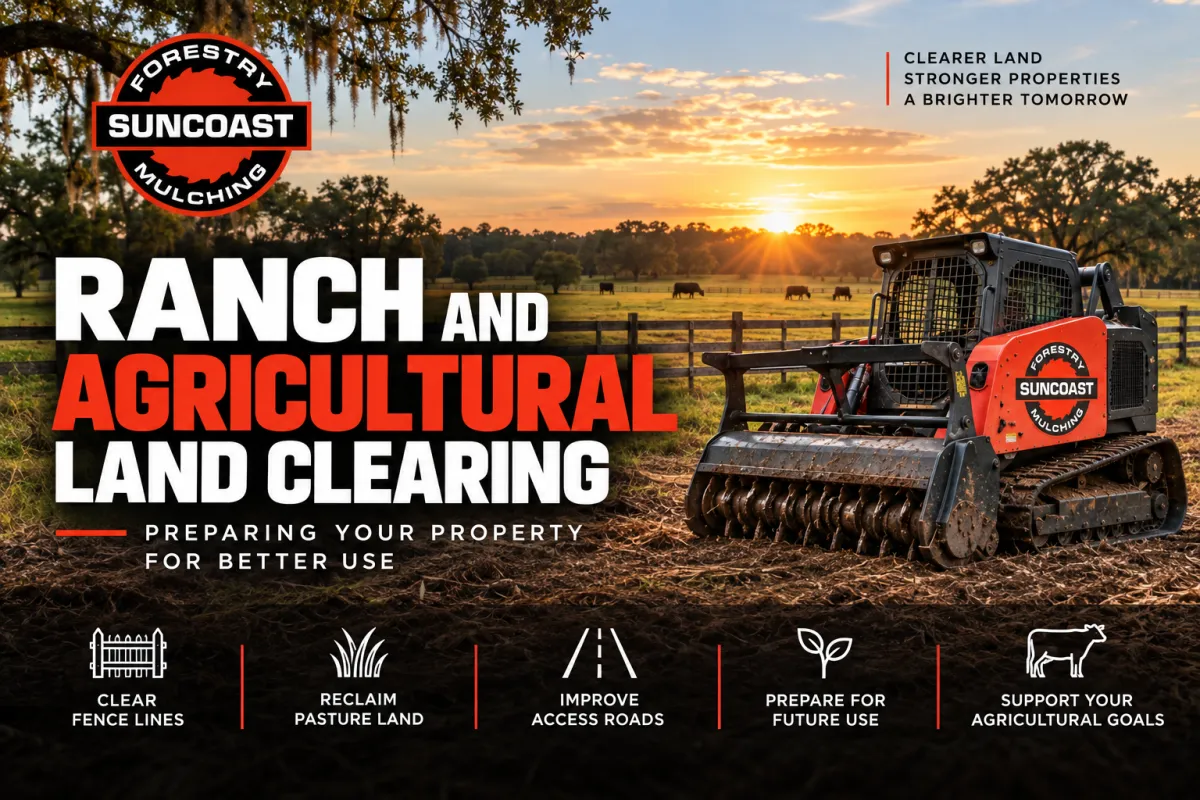
Professional land clearing and forestry mulching can help property owners reclaim overgrown areas while creating a more manageable landscape for agricultural, ranching, and recreational purposes.
Why Ranch and Agricultural Land Clearing Matters
Large properties require regular maintenance. Unlike a small residential lot, ranches and agricultural properties can contain dozens or even hundreds of acres, making vegetation management a significant undertaking.
Uncontrolled vegetation can:
Block access roads and trails
Overgrow fence lines
Reduce usable pasture areas
Make property inspections more difficult
Interfere with agricultural operations
Create obstacles for equipment
Hide drainage areas and property features
Make future development or construction more difficult
Increase the amount of work required to maintain the property
Clearing doesn't necessarily mean removing everything from the land.
In many cases, the goal is selective clearing—removing unwanted vegetation while preserving desirable trees, pasture areas, and other features of the property.
Forestry Mulching for Ranch Properties
Forestry mulching is a popular option for managing overgrown ranch land.
Instead of cutting vegetation and leaving large piles of debris behind, specialized forestry mulching equipment cuts and processes vegetation directly on the property.
Trees, brush, vines, and other vegetation can be reduced into mulch and distributed across the cleared area.
This approach can be particularly useful for ranch owners who need to reclaim overgrown sections without turning the entire property into a bare landscape.
Common Ranch Clearing Projects
Depending on the property's needs, forestry mulching can be used for projects such as:
Clearing overgrown pasture areas
Reclaiming unused sections of a ranch
Creating or improving access trails
Clearing fence lines
Opening areas around gates
Improving access roads
Creating hunting or recreational trails
Clearing around ponds and water features
Removing unwanted brush and small trees
Preparing areas for future agricultural use
The right approach depends on the property's vegetation, terrain, access, and intended use.
Clearing Overgrown Pasture Land
Pastures can become less productive or more difficult to manage when brush and unwanted vegetation begin spreading into open areas.
Over time, small trees, palmettos, vines, and other vegetation can encroach on pasture space.
Clearing selected areas can help ranch owners reclaim portions of the property and make them easier to manage.
Before clearing pasture land, it's important to determine which vegetation should remain and which areas should be opened. A thoughtful clearing plan can help protect desirable trees and preserve areas that are important to the property's overall function.
Fence Line Clearing
Fence lines are one of the most common problem areas on rural properties.
Vegetation can grow through and around fences, making them difficult to inspect and maintain. Overgrown brush may also make gates harder to access and property boundaries more difficult to see.
Forestry mulching can help clear unwanted vegetation along designated fence lines.
A cleaner fence line can make it easier to:
Inspect fencing
Identify damaged sections
Maintain gates
Access property boundaries
Perform routine repairs
Keep vegetation from becoming excessively overgrown
Regular vegetation management can also help prevent small problems from becoming much larger clearing projects later.
Improving Ranch Roads and Access Trails
Access is extremely important on large agricultural and ranch properties.
Owners, employees, contractors, and equipment may need to reach different areas of the property throughout the year. Overgrown vegetation can narrow roads and trails or make them difficult to use.
Forestry mulching can help reclaim selected access routes by removing unwanted brush and vegetation along the path.
This can be useful for:
Farm equipment access
Livestock management
Property inspections
Maintenance vehicles
Hunting access
Recreational trails
Access to remote portions of the property
If a road or trail requires grading, drainage improvements, excavation, or other work, additional services may be needed after vegetation clearing.
Preparing Agricultural Land for Future Use
Agricultural properties often change over time.
A landowner may decide to expand a pasture, create a new access route, prepare an area for equipment, establish a new agricultural use, or make improvements to an existing operation.
Before beginning any project, vegetation may need to be removed from the designated area.
Forestry mulching can be an effective first step for certain site-preparation projects because it allows unwanted vegetation to be processed directly on-site.
However, land clearing is only one part of site preparation. Depending on the project, additional grading, excavation, soil preparation, drainage work, or permitting may be required.
Selective Clearing vs. Complete Land Clearing
Not every ranch or agricultural property needs to be completely cleared.
In fact, selective clearing is often a better option when the goal is to improve the property while preserving useful vegetation.
For example, a ranch owner may want to:
Keep mature shade trees
Preserve desirable vegetation
Open only certain pasture areas
Clear a trail through wooded property
Maintain a natural buffer around a pond
Remove invasive or unwanted growth
Clear vegetation around structures
Selective clearing allows the property owner to decide which areas should be opened and which should remain untouched.
What Happens to the Vegetation?
One of the advantages of forestry mulching is that much of the vegetation can be processed directly where it is cut.
The forestry mulcher reduces brush, branches, and smaller trees into mulch, which is distributed across the work area.
This can eliminate or reduce the need to create large debris piles and haul away every piece of vegetation.
The finished appearance will vary depending on the vegetation, equipment, terrain, and desired level of clearing.
For some properties, the goal may be a relatively clean and open appearance. For others, the goal may simply be to reduce overgrowth and create better access while maintaining a more natural environment.
Benefits of Professional Ranch Land Clearing
Hiring professional land-clearing professionals can provide several advantages when dealing with large or heavily overgrown properties.
Better Access
Clearing selected areas can make it easier to reach remote portions of the ranch or agricultural property.
Improved Property Management
Open and accessible areas are generally easier to inspect, maintain, and manage.
Reclaimed Usable Space
Clearing unwanted vegetation can help return overgrown sections of a property to productive or recreational use.
Easier Fence Maintenance
Reducing vegetation along fence lines can make inspections and repairs easier.
Improved Visibility
Opening heavily overgrown areas can give property owners a better view of the land and its features.
Future Project Preparation
Clearing can help prepare selected areas for future improvements, depending on the project's requirements.
When Is the Best Time to Clear Ranch Land?
The best timing depends on the property and the type of work being performed.
Florida's vegetation can grow throughout much of the year, so waiting too long can allow small brush and saplings to become a larger maintenance problem.
Before scheduling a project, property owners should consider:
Current vegetation conditions
Soil and ground conditions
Planned agricultural activities
Livestock use
Upcoming construction or improvements
Access to the property
Weather conditions
Any applicable local requirements or environmental considerations
Planning ahead can make the clearing process more efficient and help minimize disruption to normal ranch or agricultural operations.
How Much Does Ranch and Agricultural Land Clearing Cost?
There isn't one fixed price for agricultural or ranch land clearing.
The cost can vary significantly based on:
Total acreage
Vegetation density
Size of trees and brush
Terrain
Accessibility
Amount of clearing required
Whether clearing is selective or comprehensive
Desired finished appearance
Additional services required
A lightly overgrown property will typically require a different approach than heavily wooded or densely vegetated acreage.
The best way to determine the cost is to have the property evaluated and receive a project-specific estimate.
Why Choose Forestry Mulching for Your Florida Ranch?
For many Florida ranch and agricultural properties, forestry mulching offers a practical way to manage unwanted vegetation while keeping much of the clearing process on-site.
It can be especially useful when the goal is to reclaim overgrown land, improve access, clear fence lines, create trails, or prepare selected areas for future use.
Most importantly, every property should be approached differently.
A professional land-clearing contractor can evaluate the vegetation, terrain, and intended use of the property and help determine whether forestry mulching, traditional land clearing, or a combination of services is the best solution.